@variablepulserate Small dogs tend to outlive large dogs but a considerable margin.
// @matigo @indigo @whoisashygirl
@variablepulserate Small dogs tend to outlive large dogs but a considerable margin.
// @matigo @indigo @whoisashygirl
Apple Offering 10% Bonus When Adding Funds to Apple ID in Select Countries.
https://www.macrumors.com/2020/03/23/apple-id-funds-10-percent-bonus/
Visited the GP yesterday. I've had a cold or virus (no, not BigNasty19) for almost two weeks. Clinic only allows people in the waiting room if they don't arrive by car. Your car is your own personal waiting room. Phone the clinic upon arrival, the doctor will call you back asap and conduct verbal triage. In my case he said he'd be waiting in the corridor with a precautionary surgical mask for me.
The upshot is that if my cough worsens or I become short of breath, I go immediately to whichever of two Fever Clinics is open/most accessible at the time. Both are in the same suburb, one is 24-hr at the Emergency Dept of a regional Public Hospital, the other is 10am-6pm in a private hospital. If I go there I am to present myself for COVID19 screening on the basis of being immunocompromised.
State goes into shutdown in 2.5 hours, essential services only to remain open. Leisure centre will close, membership payments will be suspended for the duration. Medical clinic will stay open but patients are to wait in their cars and register their arrival by phone. When the doctor is ready he/she will call those patients in. 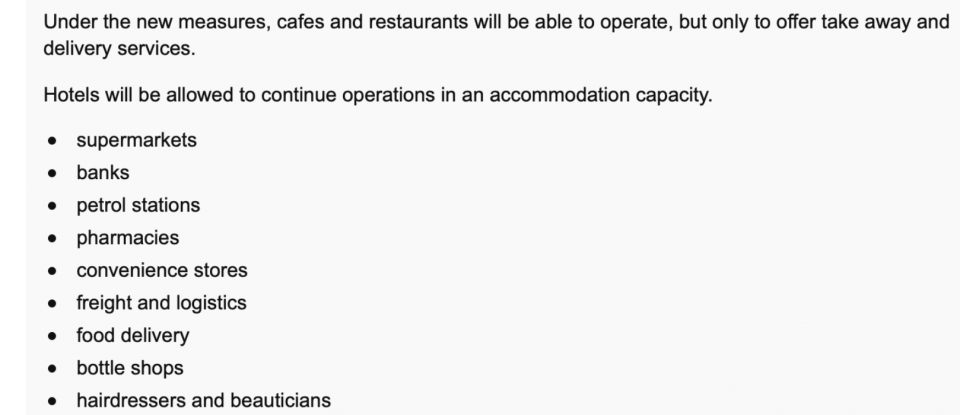
Non-essential services to be closed within 48 hours in Victoria. Supermarkets, petrol stations, pharmacies, convenience stores, freight and logistics, and home delivery will be among the services allowed to continue.
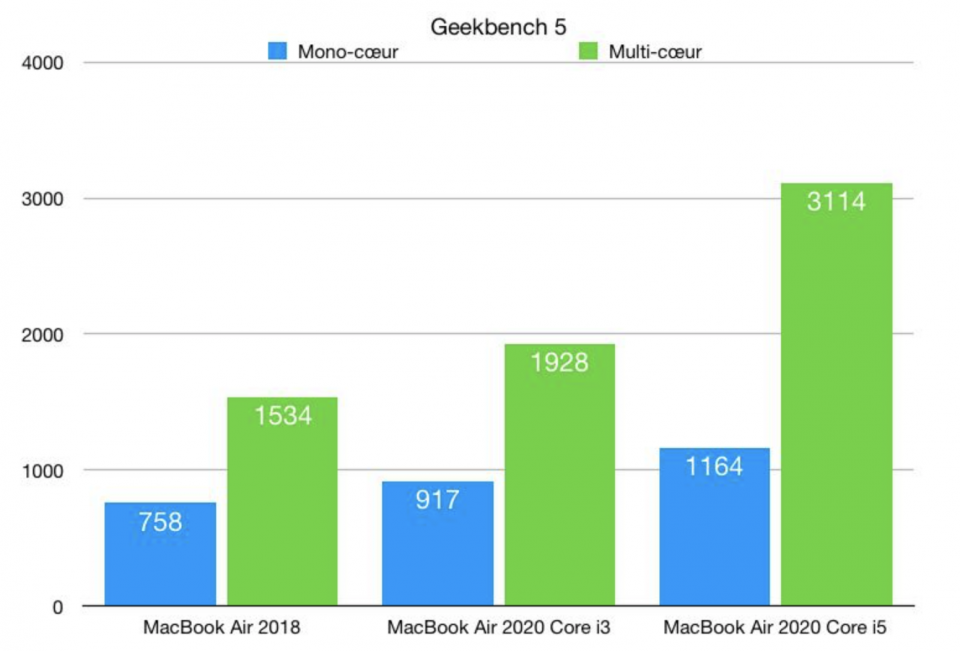
I have tracked down & translated a French website with Geekbench 5 results comparing the 13 & i5 2020 MacBook Air with the i5 from the previous 2018/19 MacBook Air.
The 1.1 GHz dual-core i3 is approx 25% faster on the multicore test: 1928 (2020 i3) vs 1534 (2019 i5).
The 1.1 GHz quad-core i5 is more than twice as fast on the multicore test: 3114 (2020 i5) vs 1534 (2019 i5).
For AU$2000 last week I could get a 2019 MacBook air with 8 GB RAM & a 256 GB SSD. For the same outlay I can now get a 2020 MacBook Air with 16 GB RAM; 256 GB SSD & a quad-core 1.1 GHz i5 processor.
Over twice the bang for the same bucks, the Geekbench 5 figures are for 8 GB RAM.
In the dim & distant past, before the ex-PMG telephone division trading as Telstra was privatised, it was run into the ground by the CEO, a shifty prick called Sol Truillo & his assorted American cronies. One of those cronies, Phil Something-or-other had recently (at the time) earned a doctorate in some business-related field.
This is where he came upon the Aussie tendency to think of a doctor as purely one of the medical or dental fraternity. Out here, you may well be entitled to refer to yourself as Dr So-and-so, but it's not something general society comes to grips with.
As "Dr Phil" found out.
"Dr Phil, you say? What's your medical field?"
"What? You're a Doctor of Philosophy? Fuck off, wanker, you're not a real doctor."
New Apple hardware released, significant upgrade to the MacBook Air with quad-core processor options, faster graphics, scissor-action keyboard & a price reduction. Plus, the 128 GB model has been replaced with 256 Gb as the entry level.
New Mac Mini with doubled storage & lower price.
New iPad Pro with LiDar Scanner (whatever that is) and trackpad support if running iPadOS 13.4 minimum.